

What is a cataract?
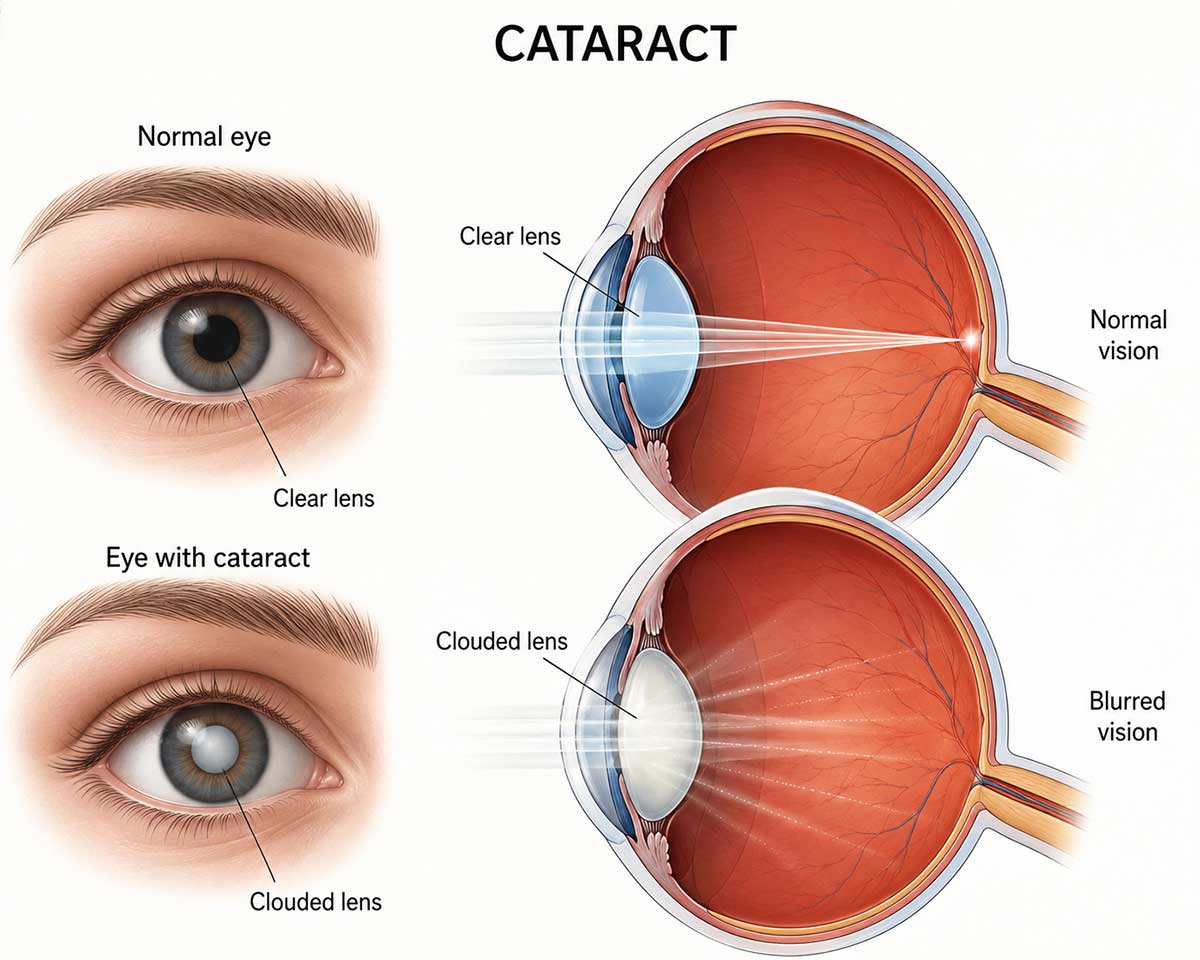
Like a camera, the eye has a lens that focuses light on the retina to produce a clear image. A cataract is a clouding of the natural lens in your eye. When a cataract develops, it prevents the light rays from getting properly focused on the retina.
In its early stages, a cataract may not cause any significant problem with the vision or limit function in any way. As the cataract progresses, it can sometimes cause a shift in the refractive error that requires more frequent updates to glasses to keep the vision clear. Eventually, the vision becomes blurry even with the best possible correction with glasses. When this interferes with visual function and quality of life, treatment may be necessary.
What are the symptoms of cataracts?
Symptoms may vary from person to person. They may include:
- Cloudy or blurry vision
- Glare or a halo in the vision, particularly with oncoming lights
- Poor night vision
- Monocular double vision
- Colours appearing faded
- Rapidly increasing nearsightedness, requiring more frequent changes to eyeglass prescriptions
How are cataracts treated?
When the visual effects of cataracts interfere with your daily activities, such as driving, treatment may be necessary. Cataracts are treated surgically. Cataract surgery is one of the most common surgeries performed in the North America. It is also one of the safest and most effective. It is performed by surgically removing the cloudy lens and replacing it with a new, artificial lens that is implanted in the eye.
When it is determined that a patient is ready for cataract surgery, the surgeon will discuss the risks and benefits of surgery, as well as details of the surgery process with the patient. Measurements are taken of the eyes before surgery, to determine the best strength of lens implant to match the eye at the time of surgery.
There are several different lens implant options available, however not all patients are candidates for all options, depending on various features of their eyes and their past ocular history. Based on the eye exam, history, and eye measurements, the surgeon will determine which lens implant options the patient may be a candidate for, and discuss this with the patient to arrive at the final surgical plan.